How AI Is Used in Fraud Detection
Deepfake voice tech helps scammers sound exactly like your CEO. Fake identities fool the verification systems you rely on. Bots can burn through thousands of stolen cards faster than you can detect them. The damage? As high as 10% of a company’s annual profits.
Criminals use AI to supercharge their attacks. Your business defense needs to be just as smart.
That's where AI fraud detection comes in — delivering real-time behavioral analysis, adaptive risk scoring, and pattern recognition that evolves with emerging threats.
If you're worried your current fraud defenses leave you vulnerable to such attacks, you need to invest in AI development.
This guide explores proven architectures, implementation strategies, essential tools, and real-world use cases for building effective fraud prevention.
What Powers AI Fraud Detection
To build robust fraud defenses, you need to understand the core technologies that make AI detection systems work.
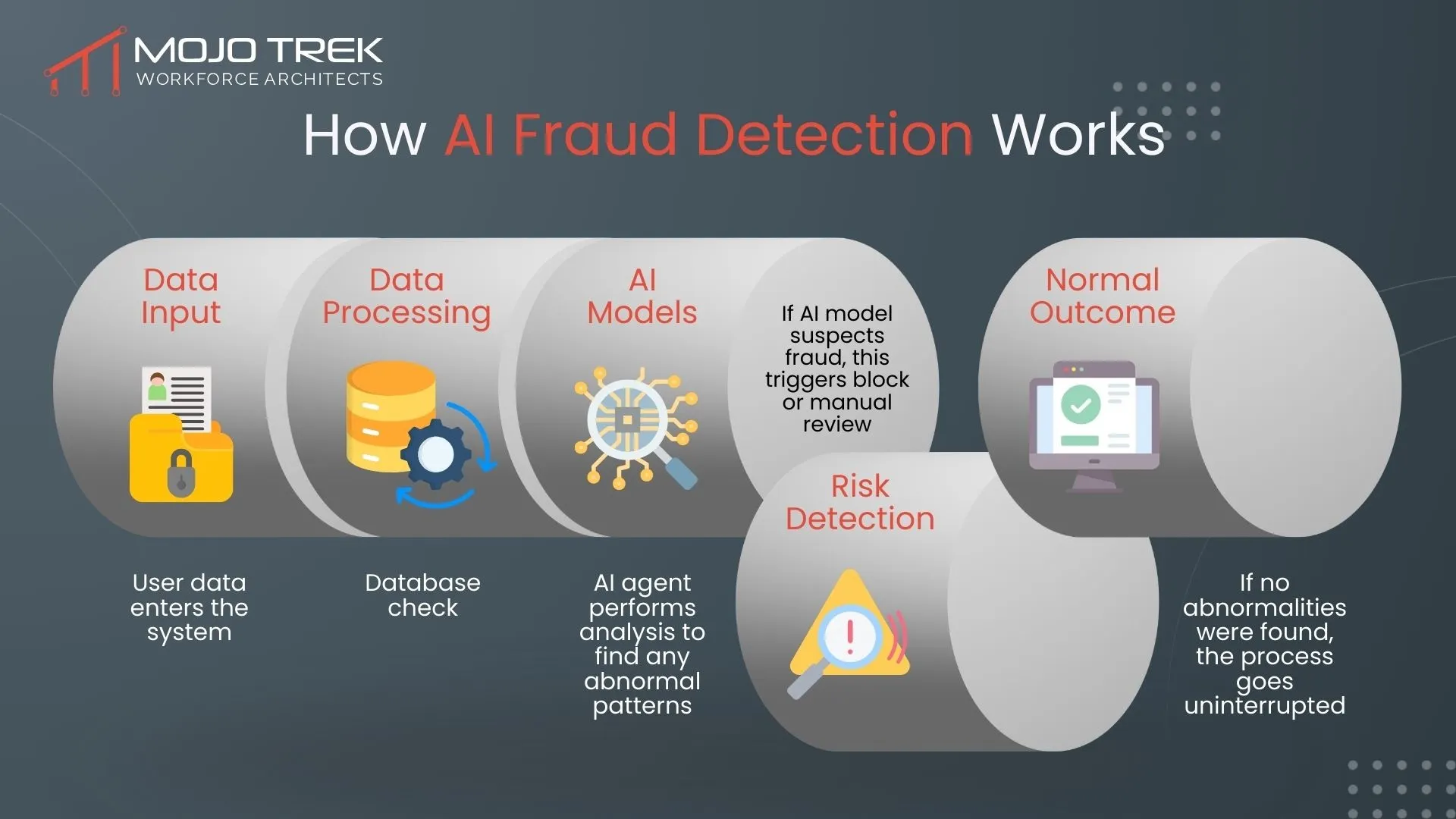
Machine Learning Models
AI fraud systems learn from millions of legitimate purchases and confirmed fraud cases.
They work in two complementary ways:
- Supervised learning catches fraud you've seen before. Feed the system thousands of confirmed fraud cases, and it identifies telltale signs, such as rapid card testing, suspicious spending spikes, or purchases from improbable locations. When new transactions show these same red flags, the system blocks them instantly.
- Unsupervised learning catches the stuff nobody's seen yet. These models study normal customer behavior and raise alerts when something feels off, even if it doesn't match any known fraud pattern. This is how you catch brand-new scam techniques before they spread.
Stripe, a payment processor, demonstrates this with their Radar system.
Graph Neural Networks (GNNs)
AI fraud systems use GNNs to map relationships between users and reveal coordinated attacks that traditional transaction-by-transaction analysis misses.
These models excel at tracking connections that matter: Shared IP addresses across "unrelated" accounts. Similar payment patterns between fake identities. Device fingerprints linking synthetic accounts to the same criminal. Rule-based systems miss these patterns because they can't see the bigger network picture.
For instance, NVIDIA's AI Blueprint helps banks and payment processors use GNNs to catch fraud rings operating across thousands of accounts in real-time.
Real-Time Detection Infrastructure

When someone swipes their card or clicks "buy now," AI fraud detection systems have roughly 100-300 milliseconds to decide before the customer notices a delay.
Meeting this deadline requires two key infrastructure components. First, GPU-accelerated computing handles the intensive AI calculations. NVIDIA's specialized hardware crunches through millions of data points instantly, running neural networks that traditional processors can't handle fast enough.
Second, cloud platforms like AWS and Azure provide scalability. During Black Friday or flash sales, payment processing can increase by 10 times its normal levels. These platforms automatically scale resources to match demand, ensuring fraud detection stays fast when you need it most.
Continuous Learning Pipelines
Fraud systems get smarter with every transaction they process. Traditional systems need manual updates for new threats, but AI models adapt automatically as they encounter fresh attack methods.
When criminals develop new techniques, such as synthetic identity schemes or novel social engineering tactics, the models adjust their detection algorithms without requiring human intervention.
Stripe built their Foundation Model on this principle. By processing billions of transactions, it delivers instant fraud detection and continuously improves its accuracy against emerging threats.
Top Uses of AI in Fraud Detection

Here's where businesses see the biggest wins when deploying AI fraud detection:
Credit Card & Payment Fraud
AI detects card-testing schemes when criminals rapidly attempt to use stolen numbers across different merchants. Instead of catching them after hundreds of fraudulent transactions, the system flags them within the first few attempts.
For example, BNY improved fraud detection accuracy by 20% using NVIDIA DGX systems, and PayPal improved real-time fraud detection by 10% running on NVIDIA GPU-powered inference.
AML & KYC Compliance
Banks utilize NVIDIA AI workflows, including XGBoost and Graph Neural Networks, to enhance AML and KYC compliance. These systems monitor complex financial networks to catch money laundering schemes and synthetic identity fraud. They track relationships between accounts, flagging suspicious fund transfers and identifying shell companies that traditional compliance systems miss.
Account Takeover & Login Fraud
AI prevents unauthorized account access through device fingerprinting, session behavior analysis, and biometric authentication. The systems analyze how users type, move their mouse, and navigate login sequences. This allows them to distinguish legitimate users from attackers, even when passwords have been compromised.
Deepfake & Identity Fraud
GenAI can now create high-quality deepfakes of identification documents that include shadows and other markers of authenticity. In November 2024, the U.S. Treasury's FinCEN issued an alert about suspected deepfake media use to circumvent identity verification. AI-powered detection systems can combat these threats through advanced voice and image analysis, identifying manipulated documents and synthetic media during verification processes.
Ready for Real-Time Fraud Protection?
Get access to global AI experts who can build, scale, and maintain next-gen fraud systems.
Benefits & Measurable Results
AI delivers real, measurable improvements that directly impact your bottom line.
Fraud Reduction That Works
Stripe's data shows impressive results across payment types: SEPA fraud dropped by 42%, while ACH fraud decreased by 20% after implementing AI-powered detection systems. These aren't marginal improvements; they represent millions of dollars in prevented losses for businesses processing high transaction volumes.
Fewer False Positives = Happier Customers
Traditional fraud systems often block legitimate transactions, frustrating customers and killing sales. NVIDIA's Graph Neural Network implementations significantly reduce these false positives, allowing more genuine purchases to pass through while still catching actual fraud. This means fewer angry customers calling support and more completed sales.
A Growing Market for Good Reason
Market growth shows businesses are all-in on AI fraud detection. Projected to reach $31.69 billion by 2029, this expansion reflects real returns on fraud prevention investments. Evidently, companies are getting measurable protection that works against evolving threats.
Building an Effective AI Fraud Detection Strategy

Success with AI fraud detection requires a comprehensive strategy that addresses infrastructure, operations, and compliance from day one.
Data Infrastructure & Computing
Your foundation begins with GPU-ready platforms, such as NVIDIA's accelerated computing infrastructure. GPU acceleration enables the millisecond response times required for modern payment processing.
Model Pipelines
Build systems that support continuous retraining on new fraud vectors. Fraudsters constantly evolve their tactics, so your models must adapt automatically. Implement pipelines that can ingest new fraud patterns and update detection algorithms without manual intervention.
Cross-Network Insights
Leverage aggregated payment-platform data for better detection accuracy. Stripe's approach demonstrates how cross-merchant insights improve fraud identification. Patterns visible across multiple payment processors often reveal coordinated attacks that individual merchant data would miss.
Regulatory & Ethical Compliance
Embed AI explainability, guardrails, and oversight into your systems from the start. Thomson Reuters emphasizes that regulatory compliance isn't optional. Your AI decisions must be auditable and explainable, especially when blocking transactions or flagging customers.
Real-Time Integration
Embed AI logic directly into payment gateways rather than treating fraud detection as an afterthought. Seamless integration ensures fraud analysis happens within the transaction flow without adding latency that degrades customer experience.
.webp)
Protect Your Business with AI-Grade Fraud Defense
Partner with Mojo Trek’s AI specialists to deploy real-time, scalable fraud solutions resistant to the latest threats.
(872) 895-79552026-01-21
Heading
Lorem ipsum dolor sit amet, consectetur adipiscing elit. Suspendisse varius enim in eros elementum tristique. Duis cursus, mi quis viverra ornare, eros dolor interdum nulla, ut commodo diam libero vitae erat. Aenean faucibus nibh et justo cursus id rutrum lorem imperdiet. Nunc ut sem vitae risus tristique posuere.
(872) 895-7955.svg)


Our Latest Insights

What Is Software Outsourcing? A Complete Guide.

How to Build a FinTech App: Development Guide