What Is Software Outsourcing? A Complete Guide.
Think outsourcing is just a race to the bottom on price?
Cost still matters. But in 2025, it's not the only reason. Companies outsource to access specialised talent in AI, cloud infrastructure, and security that they cannot hire fast enough in-house. The global software outsourcing market is projected to reach over $591 billion. That growth is a talent grab.
This guide breaks down how software outsourcing services work and how to use them strategically.
What Is Software Outsourcing?
Software outsourcing is the practice of delegating software development functions, from individual coding tasks to full product lifecycle management, to external vendors.
For years, outsourcing meant cheaper labour. But Deloitte's 2024 Global Outsourcing Survey found that 80% of executives plan to maintain or increase outsourcing investment, and cost reduction is no longer the only driver. "Access to skilled talent" and "agility" now rank just as high.
In 2025, companies outsource to innovate. They're fine-tuning models on proprietary data, building AI copilots for internal workflows, deploying RAG systems that let customers query knowledge bases in natural language, and more.
Outsourcing augments your bench. Same team, more firepower, faster releases.

The 3 Primary Outsourcing Models (And When to Use Them)
Choosing the wrong model is how companies overpay or lose control. Each structure suits a different situation, and the right call depends on how much ownership you want to retain.
Staff Augmentation (The "Extended Bench")
You hire specific engineers who report directly to your PM. The request is precise: "I need 2 React devs" or "We need a senior ML engineer for six months." They slot into your existing workflows, attend your standups, and follow your processes.
This model works best for filling skill gaps quickly or scaling temporarily during a crunch. A product launch is three months out, and your frontend team is underwater. You need a data engineer, but the role won't exist in 18 months. Staff augmentation solves the immediate problem without long-term commitment.
Dedicated Teams (The "Squad")

This is where a vendor provides a full unit: developers, QA, a project manager, etc. The team works exclusively on your product, follows your high-level roadmap, but operates with more autonomy than augmented staff.
The Dedicated Teams model suits long-term product development where domain knowledge retention matters. You want continuity without the HR overhead of managing a distributed team yourself. The squad learns your codebase, understands your users, and ships consistently over months or years.
Project-Based / Managed Services
Some companies want even less involvement. With project-based outsourcing, you hand over requirements, and they hand back a finished product. Scope, timeline, and deliverables are defined upfront. Your involvement is limited to approvals and feedback at key milestones.
This model is gaining traction. Buyers increasingly demand outcomes over hours billed, and outcome-based pricing structures are becoming more common. If you have a clear spec and want execution without managing the process, project-based works. The tradeoff: less visibility into how the work gets done.
The right model depends on how much control you need and how defined your requirements are. The wrong one costs you time, money, or both.
Why Companies Outsource in 2025 (The Data)
Companies outsource to access talent they can't find, move faster than internal hiring allows, and build flexibility into how they operate.
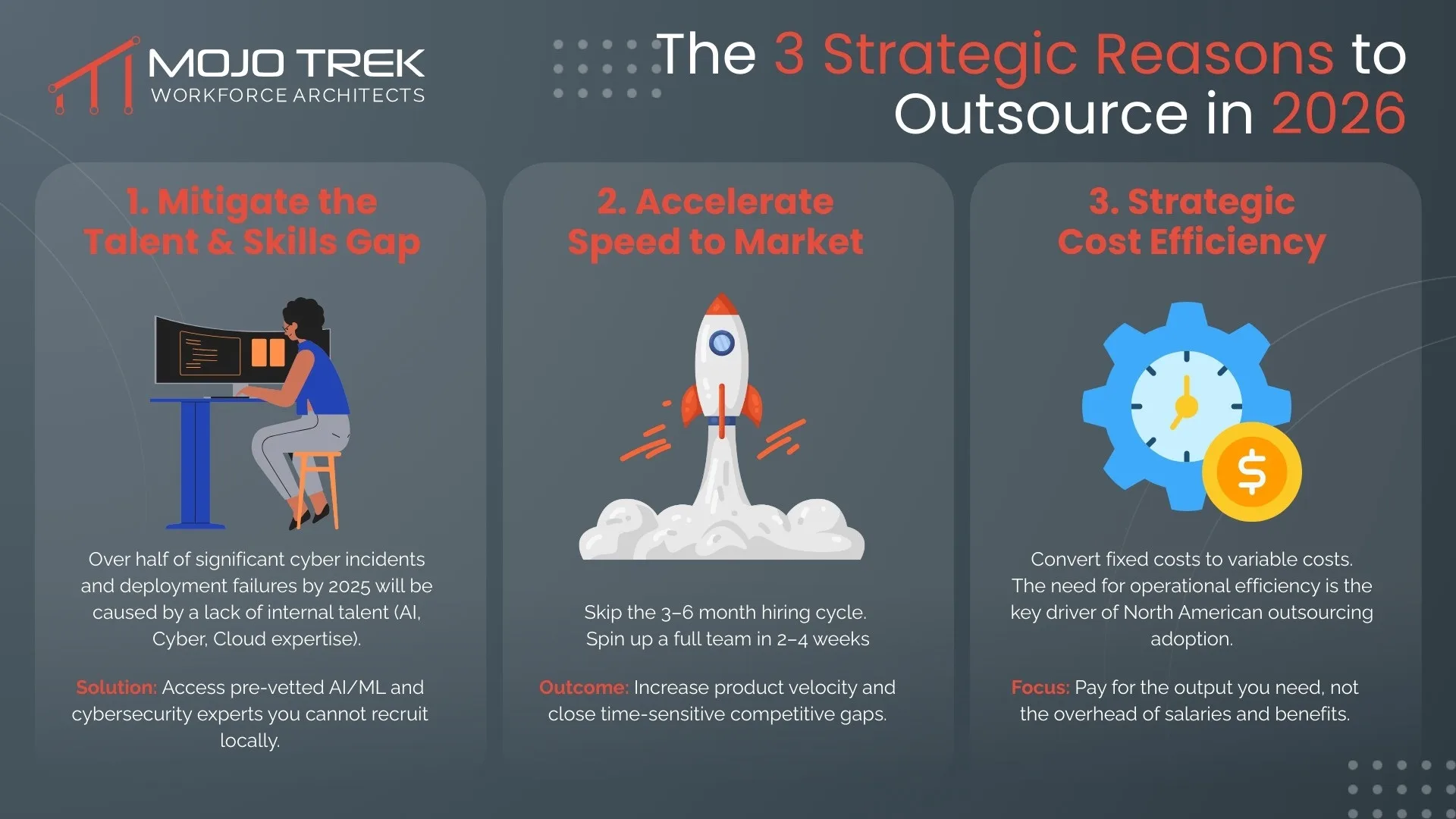
Reason 1: The AI & Skills Gap
By 2025, lack of talent will cause over half of significant cyber incidents and deployment failures, according to Gartner. The demand for AI/ML engineers and cybersecurity specialists has outpaced local supply in most markets. Companies outsource because waiting 12 months to hire someone who may not exist in their city is no longer a viable strategy.
Reason 2: Speed to Market
Hiring internally takes 3 to 6 months when you factor in sourcing, interviews, offers, notice periods, and onboarding. Software outsourcing compresses that to 2 to 4 weeks. For companies racing to ship before a competitor or hit a funding milestone, the math is a no-brainer.
Reason 3: Cost Efficiency (Strategic)
Software outsourcing converts fixed costs into variable ones. Salaries and benefits become line items you scale based on what the project needs, not headcount you're locked into year-round. Grand View Research found that this push for operational efficiency is driving North American adoption, with the region now accounting for over 32% of global outsourcing revenue.
Struggling to Hire Senior Engineers?
Stop waiting for recruiters. Mojo Trek can deploy pre-vetted senior developers and dedicated teams in as little as 2 weeks.
Nearshore vs. Offshore vs. Onshore: Choosing Your Region
You've decided to outsource. Now you need to figure out where your team should sit.
Onshore (Local)
If budget isn't your primary concern, onshore is the path of least resistance. Your outsourced team operates in the same time zone, takes the same holidays, and shares cultural context, so communication is effortless. This works best when you're building core IP or hiring technical leadership that needs to be deeply embedded with your internal team.
Offshore (Asia, India, Philippines)
If budget is a deciding factor, offshore delivers the lowest rates, typically $20 to $45 per hour. The tradeoff is a 10 to 12 hour time zone gap, which means communication becomes asynchronous by default. This works when you have clearly defined specs and don't need real-time feedback, or when you're running maintenance cycles that benefit from overnight coverage.
Nearshore (Latin America, Eastern Europe)
If you want real-time collaboration without the onshore price tag, nearshore is where most Agile teams are landing in 2025:
- Latin America (Mexico, Brazil, Colombia) aligns directly with US time zones. Your 10 am standup is their 10 am standup. Rates run $35 to $70 per hour.
- Eastern Europe (Poland, Romania) offers a strong engineering culture with overlap during US mornings, which suits teams that can front-load collaboration earlier in the day.
Complex product work requires fast feedback loops. If you can't Slack your dev and get a response within the hour, velocity suffers. For Agile teams shipping iteratively, nearshore has become the default for this reason.
Major Risks and How to Mitigate Them

Software outsourcing accelerates what you can build. It also introduces risk if you're not careful.
Risk 1: IP & Data Security
Cybercrime costs are projected to hit $12 trillion by 2025. Handing your codebase to an external team without proper safeguards is how companies end up in breach headlines. Before you sign anything, demand SOC 2 compliance from your vendor. Also, make sure NDAs are US-enforceable. If a vendor hesitates on either, walk away.
Risk 2: The "Yes Man" Culture
Some vendors will agree to any deadline to win the contract. Six weeks for a feature that realistically takes twelve. The result is rushed code, mounting tech debt, and a product that becomes harder to maintain with every release.
Forrester recommends shifting to value-based partnerships where vendors are incentivized on quality and outcomes, not hours billed. If your vendor's business model rewards saying yes to everything, your codebase pays the price.
Risk 3: Communication Breakdown
Time zones don't kill projects; silence does. The fix is to mandate at least 4 hours of daily overlap with your outsourced team. Invite them to standups, retros, and all-hands. Treat them like internal employees, not contractors on the periphery. The teams that struggle are the ones who treat software outsourcing as out of sight, out of mind.
Future Trends: What Software Outsourcing Looks Like in 2026

The market is moving fast, with two trends shaping what comes next.
AI-Augmented Development
Vendors who aren't using tools like GitHub Copilot to accelerate development are already behind. More importantly, those efficiency gains should show up in your pricing. If AI is making your vendor's team faster, you shouldn't be paying the same hourly rate as you were in 2023.
The Rise of "Hybrid" Teams
Companies are moving toward a hybrid model that optimizes cost without sacrificing velocity: core product owners stay in-house, nearshore teams handle feature development, and offshore resources cover QA and maintenance.
Each layer plays to its strengths. Strategy stays close to leadership, complex product work happens in real-time collaboration zones, and routine tasks run around the clock at lower cost. The companies that benefit the most from software outsourcing in 2026 will blend all three models.
.webp)
Scale Your Dev Team, Not Your Overhead
Get access to the top 1% of nearshore and onshore engineering talent. Flexible contracts, rigorous vetting, and 100% integration with your workflow.
(872) 895-79552026-02-11
Heading
Lorem ipsum dolor sit amet, consectetur adipiscing elit. Suspendisse varius enim in eros elementum tristique. Duis cursus, mi quis viverra ornare, eros dolor interdum nulla, ut commodo diam libero vitae erat. Aenean faucibus nibh et justo cursus id rutrum lorem imperdiet. Nunc ut sem vitae risus tristique posuere.
(872) 895-7955.svg)
Frequently Asked Questions
What is the average cost of software outsourcing in 2026?
It depends on your team's location. Offshore markets like India run $20 to $45 per hour. Latin America and Eastern Europe land between $25 and $45. North American vendors charge $90 to $200 or more. Seniority, tech stack, and project complexity also affect pricing.
What is the difference between staff augmentation and outsourcing?
Staff augmentation means hiring individual engineers who report directly to your team. You manage them like internal employees. Outsourcing means handing a project or function to an external vendor who manages the work themselves. One extends your bench. The other offloads entire deliverables.
Is nearshore better than offshore for startups?
If you need fast iteration and real-time collaboration, nearshore makes sense because the time zones align. If budget is the primary constraint and your specs are clearly defined, offshore can work. Most startups prioritise speed, which is why nearshore has become popular.


Our Latest Insights

How to Build a FinTech App: Development Guide

Healthcare Mobile App Development Guide